

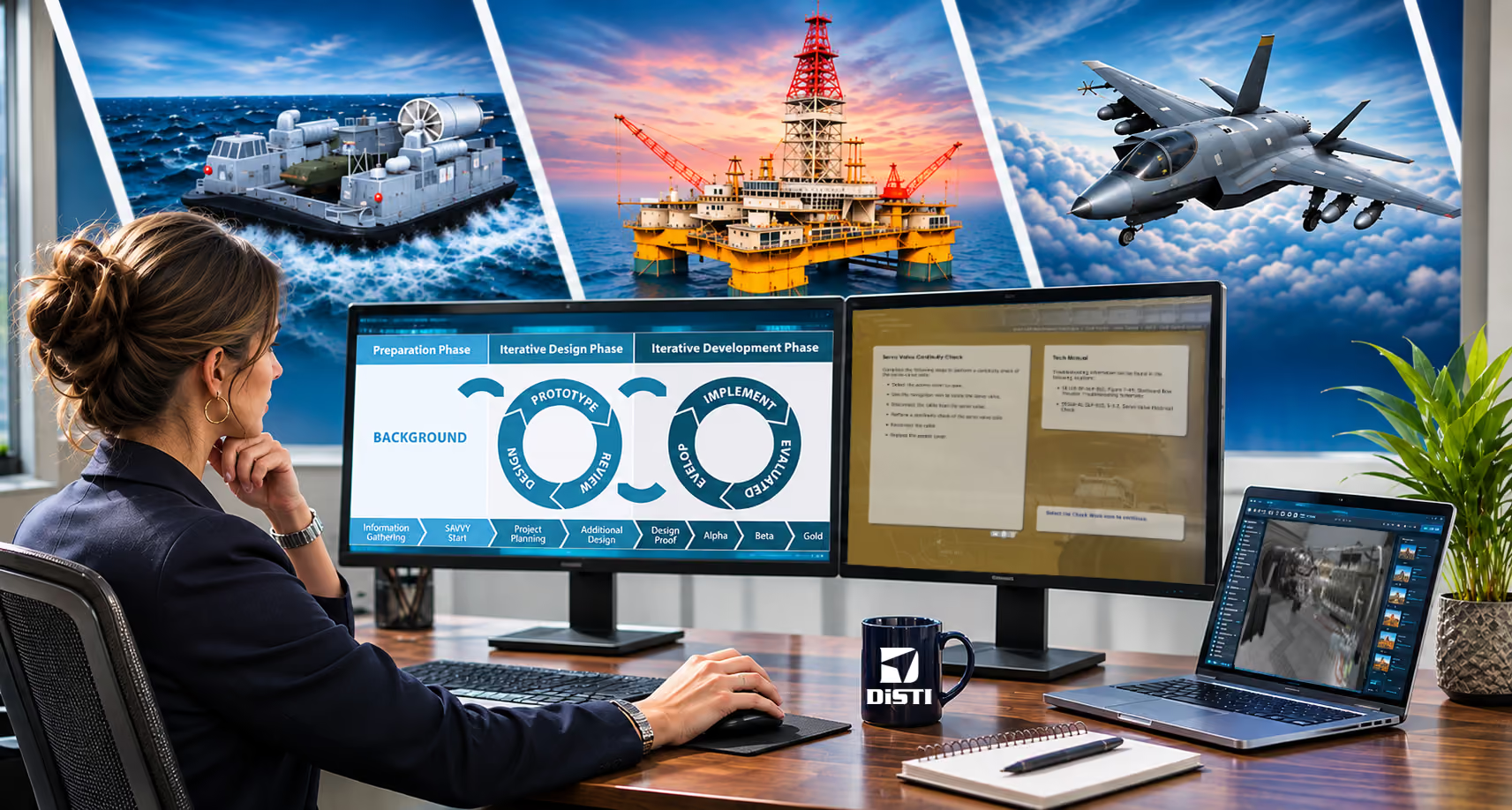
Ineffective training increases operational costs, equipment downtime, safety risks, and workforce performance gaps. Instructional Systems Design (ISD) addresses these challenges by aligning training with measurable job competencies. DiSTI's experienced instructional systems designers combine Front-End Analysis, curriculum development, and simulation-based learning to help defense, maritime, and energy organizations improve operational readiness while managing long-term training investments.
As artificial intelligence becomes increasingly accessible, organizations may be tempted to use AI-generated content as a shortcut to develop training programs, reducing costs and accelerating delivery. However, generating instructional content is not the same as designing effective instruction. AI can summarize technical manuals, organize information, and produce seemingly comprehensive courseware that still requires human oversight and validation. Still, it cannot independently validate operational requirements, understand the consequences of critical performance failures, or apply the professional judgment required to develop effective, performance-based training.
At DiSTI, we know that without experienced instructional systems designers (ISDs) guiding the process, AI-generated training risks introducing technical inaccuracies, overlooking essential competencies, and creating a false sense of workforce readiness. In environments where inadequate training can compromise safety, damage equipment, and jeopardize missions, these shortcomings can be particularly costly. AI can be a valuable tool in instructional development, but it is not a substitute for the expertise, analysis, and accountability of a qualified ISD.
A training program can feature impressive technology, photorealistic simulations, and hours of detailed courseware and still fail to prepare personnel for the job. The difference between training that looks effective and training that delivers measurable results often comes down to one critical factor: Instructional Systems Design (ISD).
For organizations operating complex, expensive, or safety-critical equipment, ineffective training carries consequences far beyond the classroom. Maintenance errors, extended downtime, inconsistent operator performance, and unnecessary reliance on physical equipment can quickly outweigh the initial cost of developing a training program.
Experienced instructional systems designers address these risks before development begins. By identifying what personnel must know, what tasks they must perform, and how proficiency will be measured, ISDs create a foundation for training that improves operational performance while protecting the organization’s investment.
At The DiSTI Corporation, instructional systems design is not an afterthought added to a simulation or courseware package. It is the foundation that determines how training is structured, delivered, evaluated, and sustained throughout a program's lifecycle.
The Real Cost of Training Is Not Development - It Is Training That Doesn’t Work
Organizations frequently evaluate training solutions based on development cost, delivery schedules, or the sophistication of the technology being used. Yet the true financial impact of training becomes apparent after implementation.
A program developed without experienced instructional design oversight may deliver technically accurate content but fails to address the skills personnel need to do their jobs.
The consequences can include:
- Longer training timelines: Personnel spend additional time learning material that may not directly support their operational responsibilities.
- Higher operational costs: Training depends unnecessarily on expensive equipment, facilities, instructors, or operational assets.
- Inconsistent proficiency: Personnel complete training without demonstrating the same level of task competency.
- Inconsistent proficiency: Personnel complete training without demonstrating the same level of task competency.
- Expensive redevelopment: Organizations discover instructional deficiencies after courseware, simulations, and hardware investments are already complete.
These issues are particularly costly in defense, maritime, and energy environments, where equipment availability, workforce proficiency, and operational safety directly influence mission success. The question is not simply whether an organization can develop a training system. It is whether that system will produce the required performance at a sustainable cost.
Why Experienced Instructional Systems Designers Change Training Outcomes
Instructional Systems Design applies a structured, performance-based methodology to develop training solutions. Rather than beginning with content or technology, experienced ISDs begin with operational requirements. What must the learner accomplish? What knowledge and skills are required? Which tasks present the greatest difficulty or risk? How can personnel demonstrate proficiency before working on operational equipment?
These questions guide every subsequent development decision. DiSTI’s instructional systems designers use training delivery methods including Front-End Analysis (FEA), media analysis, curriculum development, instructor-led training, Interactive Multimedia Instruction (IMI), simulation-based learning, and ongoing training evaluation. This approach ensures training requirements drive the solution rather than letting technology dictate how instruction is delivered.
How ISD Improves Training Performance and Economics
The result is a training program designed around measurable performance rather than the volume of content delivered.
Defense Training: Improving Readiness Without Increasing the Burden on Operational Equipment
For military organizations, training effectiveness directly influences readiness. Personnel must develop proficiency on increasingly sophisticated platforms while balancing limited equipment availability, constrained training schedules, and evolving operational requirements. Traditional training methods often require access to operational vehicles, aircraft, or vessels, creating competition between training and mission requirements. Experienced ISDs help determine which tasks require hands-on instruction and which can be effectively taught through interactive courseware, part-task trainers, or virtual environments.
This distinction can reduce unnecessary equipment utilization, allow personnel to practice procedures repeatedly, and help preserve operational assets for their intended missions.
DiSTI’s Experience Supporting U.S. Navy Training
Since 2011, DiSTI has supported the U.S. Navy’s Landing Craft Air Cushion (LCAC) program by developing and modernizing operator and maintainer training. Using established ISD methodologies, DiSTI developed training for multiple operational roles, including Craft Pilots, Flight Engineers, Loadmasters, Deck Engineers, and maintenance personnel.
This role-specific approach addresses a fundamental challenge in complex military training: different personnel interact with the same platform but require distinctly different knowledge, procedures, and performance competencies. DiSTI’s experience continues with the U.S. Navy’s Ship-to-Shore Connector (SSC) program. Under a contract awarded in 2025, DiSTI is responsible for instructional systems design efforts supporting more than 1,200 hours of operator training.
The program integrates Front-End Analysis, instructor-led instruction, interactive multimedia, hardware-based part-task trainers, full-motion simulators, and live craft instruction. Rather than treating each training medium as a separate deliverable, the ISD process determines how these elements work together to prepare personnel for operational responsibilities.
The operational advantage: Training can be distributed across the most appropriate environments, reducing avoidable reliance on live equipment while supporting consistent preparation and measurable competency.
Maritime Training: Building Proficiency When Access to Vessels Is Limited
Maritime operators face a distinct training challenge: vessels are expensive to operate, difficult to make available for instruction, and often geographically separated from the personnel who need training. Submarines, commercial vessels, offshore platforms, and specialized maritime systems require personnel to understand complex equipment and procedures before assuming operational responsibilities.
Training exclusively aboard operational vessels can increase scheduling complexity, consume valuable crew time, and limit opportunities to practice uncommon or hazardous scenarios. Instructional systems designers help identify which competencies can be developed through shore-based instruction, procedural trainers, and immersive simulation before learners transition to live equipment.
Designing Training for the Next Generation of Maritime Operations
DiSTI’s work on the REGENT Seaglider program demonstrates how instructional systems design supports emerging maritime technologies. Selected to develop 314 hours of operator training curriculum, DiSTI’s responsibilities include Front-End Analysis, media analysis, course syllabi, training allocation across instructional environments, and curriculum for Captains and Watch Officers. The program also encompasses course pilots, train-the-trainer activities, and support for the U.S. Coast Guard certification process. By establishing instructional requirements early, DiSTI helps create a coordinated training structure that can evolve alongside the vessel and its operational requirements.
For maritime organizations, this approach offers substantial potential advantages: fewer training-related demands on operational vessels, improved standardization across crews, and greater flexibility to deliver instruction across multiple locations.
Oil and Energy: Where Training Quality Directly Influences Safety, Downtime, and Productivity
In the oil, gas, and energy industries, an incorrectly performed maintenance procedure can have consequences far beyond the cost of retraining an employee. Gas turbines, power generation equipment, industrial machinery, and energy infrastructure require personnel to execute complex procedures accurately, often under demanding operational conditions.
Errors involving equipment isolation, lockout/tagout procedures, component alignment, or maintenance sequencing can result in equipment damage, unplanned downtime, and serious safety incidents. For these industries, effective training must do more than explain a procedure. It must prepare personnel to perform it correctly.
Applying ISD to High-Consequence Industrial Tasks
DiSTI’s instructional design experience includes the Siemens Gas Turbine Alignment Training System and Siemens Gas Turbine Tag-Out/Lock-Out Trainers. These applications illustrate the value of combining task-focused instructional design with interactive training technologies.
Through detailed task analysis, experienced ISDs can identify critical procedural steps, common errors, required safety precautions, and appropriate assessment criteria. Interactive training can then provide opportunities to practice these procedures without exposing learners to the risks or operational costs associated with live industrial equipment.
For energy operators, the potential financial advantages extend across the equipment lifecycle:
- Reduced dependence on operational machinery for initial training.
- More consistent instructions for maintenance and safety procedures.
- Less instructor time is spent repeatedly demonstrating foundational tasks.
- Improved preparation before personnel perform work on live systems.
- Scalable training that can support multiple facilities and geographically dispersed workforces.
In industries where unplanned downtime can be exceptionally expensive, preventing even a small number of avoidable procedural errors can materially improve the value of a training investment.
The Risks of Developing Training Without Experienced ISDs
One of the most consequential decisions an organization can make is treating instructional design as an optional service rather than a core program requirement.
Engineers, subject matter experts, and software developers are essential to building technically accurate training solutions. However, technical expertise alone does not guarantee instructional effectiveness.
A subject matter expert understands how a system operates. An experienced instructional systems designer understands how to translate that knowledge into a structured learning experience that produces demonstrable proficiency.
Without that distinction, organizations expose themselves to several avoidable risks.
- Technology Becomes the Focus Instead of Learning
An organization may invest heavily in virtual reality or sophisticated simulation without first determining whether the technology is necessary for the tasks being taught. The result can be an expensive training environment that delivers little additional instructional value. Experienced ISDs use media analysis to determine where advanced simulation improves learning and where simpler, less expensive instructional methods are sufficient. - Critical Skills and Procedures Are Overlooked
Training developed directly from technical manuals or engineering documentation may fail to capture the decisions, practical skills, and procedural knowledge required in operational environments.
Front-End Analysis and task analysis help identify these requirements before curriculum development begins. - Training Effectiveness Becomes Difficult to Measure
Without clearly defined performance objectives and assessment criteria, organizations may know how many employees completed training but have little evidence of what those employees can actually do.Experienced ISDs establish measurable objectives that connect instructional activities to operational performance. - Development Costs Increase Through Rework
When instructional requirements are poorly defined, deficiencies often surface during testing, implementation, or actual operations.Correcting those problems can require redesigning courseware, revising simulations, and repeating validation activities.Identifying instructional requirements before development reduces the likelihood of these expensive changes. - Training Investments Lose Value Over Time
Training programs must evolve as equipment configurations, operational procedures, and workforce requirements change.
Without a sustainable instructional architecture, even relatively minor updates can trigger disproportionate redevelopment costs.
Experienced ISDs plan for maintainability, content reuse, and technical refresh from the beginning.
The greatest risk of excluding instructional design is not that a training program will fail to function. It is that the program will function exactly as developed while failing to produce the operational performance it was purchased to deliver.
The Long-Term ROI of Instructional Systems Design
The financial value of instructional systems design extends well beyond initial courseware development.
When training is structured around operational requirements, organizations can reduce recurring costs while improving how effectively personnel learn and retain essential skills.
The strongest return on investment often comes from avoiding unnecessary expenditures throughout the training lifecycle.
Where ISD Creates Financial Value
These benefits compound as training programs expand across additional students, sites, equipment configurations, and years of operation.
For example, a training program that reduces the number of hours personnel must spend on operational equipment can generate recurring savings with every new training class. Similarly, reusable instructional content can reduce the cost of supporting new equipment variants or updated procedures.
An effective ROI evaluation should therefore consider the total cost of training ownership, including development, delivery, instructor labor, equipment utilization, remediation, updates, and sustainment.
Actual savings depend on program scope, training volume, baseline costs, and measured performance improvements. Establishing those metrics early allows organizations to demonstrate the value of their training investment rather than relying on assumptions.
Why DiSTI Integrates Instructional Design with Advanced Training Technology
DiSTI combines experienced instructional systems designers, courseware developers, simulation engineers, and technical specialists to create training solutions that connect instructional objectives with operational requirements. Its end-to-end capabilities include Front-End Analysis, media selection, curriculum development, Levels 1–4 Interactive Multimedia Instruction, instructor-led training, simulation-based learning, Extended Reality (XR), Learning Management System integration, train-the-trainer support, and post-delivery sustainment.
This integrated approach is particularly valuable for organizations managing complex training requirements across multiple roles, locations, and equipment configurations. Rather than beginning with predetermined technology, DiSTI evaluates the training requirement and identifies the instructional methods best suited to the task. The result may include traditional courseware, desktop training, immersive virtual environments, hardware-based trainers, or a coordinated combination of these solutions. DiSTI’s experience across U.S. Navy LCAC, Submarine, and SSC programs, naval aviation training, emerging maritime systems, and industrial equipment training demonstrates the company’s ability to apply this methodology across diverse operational environments.
Make Instructional Systems Design Part of the Investment Decision
Organizations planning new training initiatives often focus heavily on hardware, software, visualization fidelity, and development schedules. Instructional design deserves equal consideration.
Before committing to a training architecture, program leaders should understand how they will establish learning objectives, select instructional media, evaluate proficiency, and sustain the system over time. Addressing these questions early can prevent costly redesign, reduce unnecessary technology expenditures, and create a more defensible business case for training modernization. For defense, maritime, and energy organizations, the right instructional strategy can make the difference between purchasing a training product and investing in a sustainable workforce capability.
Conclusion: Better Training Begins Before Development
A training system's effectiveness is not determined by how sophisticated it looks or how much content it contains. It depends on whether personnel can perform their jobs safely, consistently, and efficiently after completing the training.
Experienced instructional systems designers make that outcome the starting point. By identifying operational requirements, selecting appropriate instructional methods, and establishing measurable performance objectives, ISDs help organizations reduce wasted training expenditures, improve workforce proficiency, and maximize the long-term value of their training investments. For organizations operating complex military platforms, maritime vessels, or critical energy infrastructure, excluding experienced ISDs can introduce unnecessary financial and operational risk. Technology delivers the training experience. Instructional Systems Design ensures that experience delivers results.
DiSTI brings instructional expertise and advanced simulation capabilities together to develop training solutions designed for real-world performance, operational readiness, and long-term value. Learn how DiSTI can help improve your training outcomes while reducing lifecycle costs through its Instructional Systems Design and Courseware Development services.
Is Ineffective Training Costing You More Than You Think?

